

Audio Description of 'Echoes of Our Heritage'
Echoes of Our Heritage showcases several pieces from American Ancestors’ extensive collection of manuscripts, art, photographs, books, and historical objects. This dynamic work prompts us all to reflect on our history, both personal and collective, and the diversity of the American experience.
Created by Pamela Hersch (1984 – ), Commissioned by American Ancestors 2024.
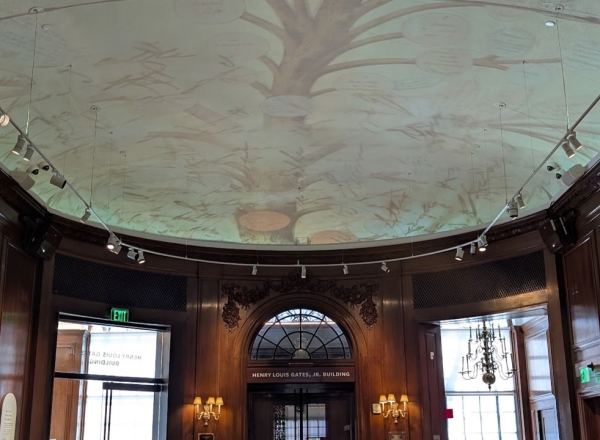
Above you is a projection covering the entire curved ceiling. It plays in a continuous loop approximately 5 minutes long. If you’re here on a sunny day it may appear as pale beige in tone, with lower contrast than if you’re here on a cloudy day, or after sunset.
Overall, it’s an atmospheric collage of images. Most are from the collections of American Ancestors, which are available to researchers on the upper floors of the library. The projection, by artist Pamela Hersch, is titled “Echoes of Our Heritage”. It evokes a sense of time, and generations, from the 1700s through the more recent past.
Many of the images have warm beige tones as backgrounds, with darker brown marks of cursive ink handwriting. Some include larger letters in elaborate calligraphy. One page with very large words says: “A Genealogy / Anno Domini / 1743”.
Others have smaller handwriting, also in brown. At times these appear from multiple directions.
One image is an illustration with pale colors of red and green, and blue hills in the far distance. It includes a ship in brown lines. A thin horizontal element across the whole image suggests that we’re viewing the scene through a window, with parted red curtains.
Another image has large calligraphic handwriting with elaborate decorations. These flourishes include dark diamond shapes within a large letter M. The M is the beginning of the words: “Marriage is Intended / Between Thomas Marshall and Anne Manwaring”.
This page fades into an image with curving pink ribbons, tied with bows and tassels. Within the ribbons are the words “Family Register.” Columns between the ribbons, each with blank lines for entering information, are titled: “Name of the Family.” / “When and Where Born.” / “When and Where Married.” / “When and Where Died.”
Appearing over the whole projection for a few moments is a pattern of curving green designs against a dark background.
From one of the short sides of the projection, a wide brown tree trunk appears. It has branches with circles, most in pale blue and pink. On each circle is information about individuals in the family. As the image scrolls upwards, smaller branches and circles appear, along with pod-like forms also filled with names.
In a photo with overall brown tones, four men are sitting on horseback, with a fifth man standing in front of them. We view them in profile. They all wear prominent headdresses with long feathers, regalia of the Sioux Tribes of Native Americans.
Another photo shows three rows of people posing in front of an open doorway to a building with weathered boards. The people, with various brown skin tones, look at the camera. In the row at the bottom, seven children sit side-by-side on a step. The row above them has two seated adults, and uppermost row has six people standing. The photo is identified as showing a sharecropper family in the American South in the late 1800s.
Another group portrait shows rows of light-skinned men clasping their knees as they sit on the ground. They all wear matching clothing, consisting of a wide-collared coat, and a hat with a tall crown and a wide brim with thin ropes tied around it. They’re soldiers from an American Northeast Company during World War I.
There’s also one group photograph of women. They sit in five rows, with others flanking them to the left and right. Many are smiling as they look into the camera. They’re students from Wellesley College in Massachusetts, in 1952.
Another photo shows a crowd of people standing outdoors, close by one another on an urban street. Many have their arms crossed, and most have serious or sad looks on their faces. It’s a photo taken at the dedication of The New England Holocaust Memorial in Boston, in 1995.
This photograph, along with the images of the Wellesley College students, and the World War I soldiers, are from the Wyner Family Jewish Heritage Center at American Ancestors.
Another image is a drawing of an extremely dense family tree design. Its root-like elements fork rectangularly in an overall pattern.
As this fades into multiple rows of handwriting in different directions, portrait photographs slowly appear around the perimeter of the projection. There are sixteen in total. These are the heads and upper bodies of a wide array of women and men of different ages and skin tones. They wear clothing suggesting different time periods.
From here the loop begins again.